The Best Air Purifier
When it comes to air purifiers, CADR is king. CADR is the rating assigned by the Association of Home Appliance Manufacturers, and it tells you what size room the best air purifiers can, well, purify. We tested out eight that were rated to clean close to 360 square feet of pollen, dust, and tobacco smoke, then spoke with air quality specialists and physicians about the importance of true HEPA filters and other features before landing on our two top picks.
Excellent clean-air ratings, slick looks, and killer bells and whistles at budget prices make this an easy top pick.
Equally lightweight, quiet, and effective as our top pick. If you prefer the looks of the Coway, it's a great choice.
- December 13, 2017 — We’ve updated our review to assess a total of 85 air purifiers, up from 45 when we first published. Air purifiers from two new brands — Electrolux and Kenmore — met our specifications, but after trying them out for ourselves, our hearts still belong to the Winix and the Coway. Of all our finalists, they continue to offer the best balance of competitive CADR ratings, reasonable pricing, and intuitive design.
The 2 Best Overall Air Purifiers
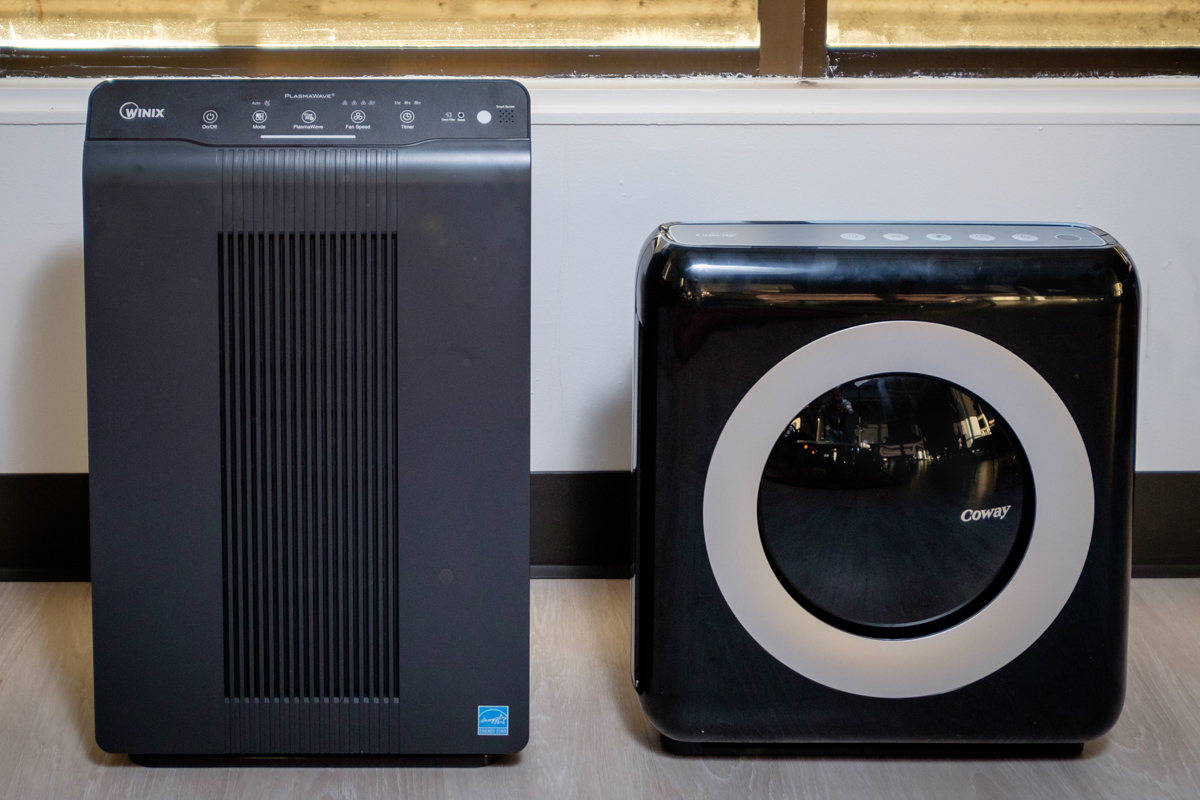
Left: Our top pick, the Winix 5500-2 Air Cleaner. Right: the bubblier Coway 4-Stage Filtration System.
Pop quiz: What’s dirtier — the air inside your home or the air outside of it? According to studies conducted by the Environmental Protection Agency (EPA), the air inside a home might be two to five times more contaminated with pollutants, be it animal dander, cigarette smoke, or soot.
Enter the air purifier. They can be hugely beneficial for allergy and asthma sufferers, as well as anyone who lives near major highways or other pollutant-filled areas, like coal plants. The best ones use fans to cycle air through a series of filters, capturing impurities and jetting clean air back into the room. Choosing the right one comes down to its CADR rating — the measurement for how well an air purifier actually works. Aside from that, the right type of filter — a true HEPA is key — and making it sure it can accommodate the size of room you want will have you breathing easy.
The Winix 5500-2 Air Cleaner is our top pick due to impressive CADR ratings and slightly better construction than our runner-up. It’s powerful enough to cover 360 square feet, about the size of an average master bedroom (although it’ll work just as well in smaller spaces). The Winix can clean the air in a room up to four and a half times per hour — exceeding the minimum four times recommended by experts. It has an easy to replace True HEPA filter plus intuitive controls. Manufacturer pricing is $250, but we’ve consistently seen it listed on Amazon for $135 over the past year.
The Coway 4-Stage Filtration System came incredibly close to taking our top spot. Like the Winix, it has top-tier CADR ratings and can cover up to 360 square feet. It’s slightly more powerful, capable of cleaning the air in a room five times per hour. But the filters are a little more difficult to replace, and the Coway tends to be more expensive, typically retailing for $230. It’s a great choice for those who like it’s bubbly design or during the rare occasion when the Winix isn’t available.
How We Found the Best Air Purifier
Our review started with a roundup of 85 portable air purifiers designed for home use — think living room, not warehouse. We only considered purifiers with at least a one-year warranty on the entire unit, plus those with Energy Star certification. (In order for your air purifier to be effective, it has to run pretty much constantly. This can significantly increase your electricity bill, and we wanted to alleviate that increase as much as possible.)
We also targeted purifiers that covered no more than 400 square feet, roughly the size of a living room or large master bedroom. There are purifiers that are designed to cover larger spaces — even entire homes — but these units can run into the thousands of dollars. Portable air purifiers are designed to save energy and clean individual rooms effectively and will be sufficient for most people.
We compared CADR ratings to see which purifier cleaned the best.
Since the 1980s, the Association of Home Appliance Manufacturers (AHAM) has performed independent tests on air purifiers to see how quickly they can remove particles from the air — the clean air delivery rate, or CADR.
Ray Wu, CEO of Wynd and air quality expert, explained “for a whole room air purifier, CADR is the most important cleaning metric.” It has limitations: CADR can’t evaluate odor or chemical purification, just the larger pollutants caught by an air purifier’s filters — but it’s the widely accepted standard by which air purifiers are measured.
CADR ratings are complicated. Each purifier gets three: one for how well it removes pollen from the air, one for how well it removes dust, and one for how well it removes tobacco smoke — the three most common particulates in an average home. Each rating is determined by both the amount of air that flows through the machine and how efficiently it removes the particles. This weeds out purifiers that are great at removing particles, but only do so with a very small amount of air; or conversely, purifiers that cycle quickly through a huge volume of air, but don’t purify very well.
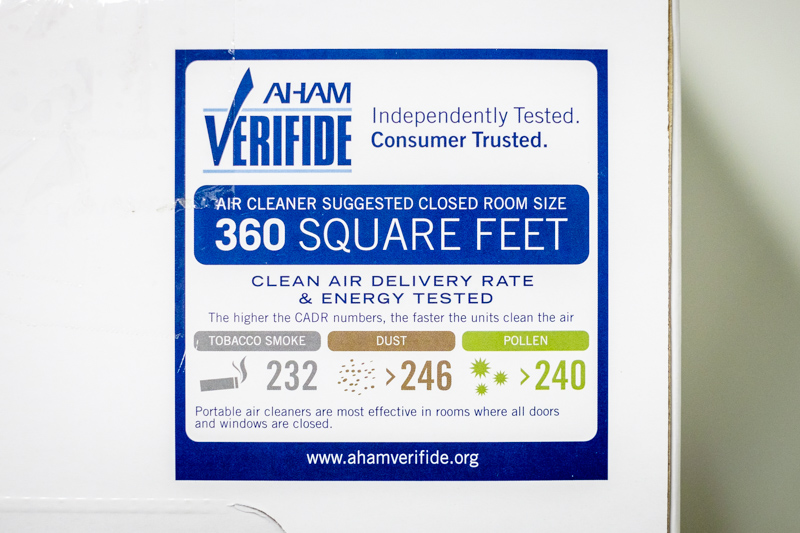
An AHAM CADR rating label. These are listed right on the box of any AHAM-verified air purifier; this one is from the Coway 4-Stage Filtration System, one of our top picks.
For the most part, the higher the CADR numbers, the better.
Consumer Reports judges a CADR score to be “excellent” if it’s 350 and above, and “poor” if it’s 100 or below. Wu explained to us that a higher number means the units have more powerful fans and bigger HEPA filters to “clean more air per hour.” But if you wanted to purify the air of a small bathroom, you could very well get away with a CADR rating of 100 — just not so much in a master bedroom or a room with vaulted cathedral ceilings. Many units on our list had CADR ratings around 150, some as low as 60.

Left: The slender HEPA filter of the Winix 5500-2. Right: The trio of HEPA filters from a Honeywell HPA300, which are fatter and have more surface area.
To make it easier for you to find the right amount of coverage, the AHAM uses CADR ratings to calculate the maximum square footage a unit can purify. This square footage is tied to air exchanges per hour (ACH), or how often the unit will cycle through all the air in the room. Most portable, at-home units have an ACH between four and six, the amount recommended by allergists. “The more the better,” says Dr. Petrizzo, “but at minimum four.” (For context, the American Society of Heating, Refrigerating, and Air-Conditioning Engineers recommends an ACH of four for hospital patient rooms, six for intensive care units, and a whopping 25 for operating rooms where sterile air is critical.)
For this review, we focused on units that offered the highest CADR ratings and ACH rates we could find (which averaged around 200-300 and 4-6, respectively), although we left off one model, the $1,500 Airgle AG500, that had an exorbitant price tag coupled with mediocre specs.
Blueair 205
Coway AP-1512HH
Electrolux EL500AZ
Honeywell HPA300
Idylis AC-2119
Kenmore 437.8339641
SheerAIRE AC-2045DC
Winix 5500-2
Winix True HEPA U450 Air Cleaner
Our top picks also had to have a True HEPA filter.
We wanted to make sure our top picks used reliable, long-lasting filters. For air purifiers, a True High Efficiency Particulate Air (True HEPA) filter is the gold standard, recommended by organizations from the EPA, to the American Lung Association, to the American Academy of Pediatric Allergy and Immunology.
True HEPA filters force air through a sticky membrane, and can capture up to 99.97 percent of particles as small as 0.3 microns. (For reference, the smallest particle the human eye can detect is 40 microns, or about the diameter of a single strand of human hair.) Dr. Marie Cavuoto Petrizzo, a New York physician, says she “always recommends HEPA air purifiers because they are best at trapping small particles such as pollens, dander from pets, mold spores, et cetera.”
HEPA type filters — which look and sound like True HEPA filters but without meeting all the standards — can have high CADR ratings but shorter lifespans. That means you’ll have to buy more replacements. A True HEPA filter is like an insurance policy for quality and your wallet.
Three brands fell out of the running here. SheerAIRE and Idylis both offered models that advertised HEPA filtration but proved to have only HEPA type filters upon inspection. Blueair, meanwhile, uses a proprietary filter that promises to be better than a True HEPA, but we couldn’t find any research to support these claims. Given the lawsuits that have been made over misleading air purifier claims in the past, we opted for models with transparent, proven-effective technology.
...And a pre-filter plus a secondary filter.
To make sure that the True HEPA filter would last as long as possible, we also looked for two additional components in each of our finalists:
A pre-filter is a sort of bodyguard for your primary filter. These screens work as the first line of defense, capturing large airborne particles like dust and pet hair that would gunk up the main HEPA filter, which is what actually “purifies” the air. “Basically pre-filters increase the lifespan of the HEPA filter,” Wu told us. Pre-filters last for about three months, then they’ll need to either be replaced or, with lots of models, washed or vacuumed.
Secondary filters add to a unit’s efficacy and can boost the lifespan of the HEPA filter — the HEPA doesn’t need to work so hard if it has some help. We preferred charcoal as a secondary filter, which absorbs gases and odors too small for a HEPA filter to catch.

Clockwise from left: A pre-filter, which often looks like a window screen, a true HEPA filter, and a secondary filter, with pockets of charcoal.
All of our remaining air purifiers met these two benchmarks, although they took different approaches. Units by Kenmore and Electrolux combined charcoal or activated carbon in their pre-filters rather than placing it in a separate, secondary filter, theoretically cutting down on the number of replacement filters you need to purchase, although it probably won’t save you any money. “Mixing the carbon with the pre-filter doesn’t hurt and is convenient, but you’ll still have to keep replacing them. A regular pre-filter just needs to be cleaned,” Wu pointed out. Our other five finalists took a more traditional approach, with separate pre- and secondary filters.
There are three other types of filters that can also show up in air purifiers. Two are neither here nor there — they may work, but there aren’t proven effective like charcoal and true HEPA filters — and there’s one we actively avoided.
- Negative ion filters send electrically charged ions out into the air. These ions latch onto pollutants and particles, which then stick to ceilings, walls, or the floor so you no longer breathe them. The experts we spoke with were not huge fans of ionizers, since they don’t really clean the air so much as “ground” the junk floating around in it. Our runner-up, the Coway 4-Stage Filtration System, does offer this feature, but it can be turned off without affecting the machine’s performance.
- UV filters attempt to sanitize the air by zapping particles with rays of ultraviolet light as they pass through. The GermGuardian unit that we looked at offers this feature, but the jury is out on whether it actually works. “UV light doesn’t have effective proven results in air purifiers,” Fatima Puri, air quality specialist at AlenCorp, told us. “Air moves way too quick.”
- Ozone filters emit charged particles that attract pollutants, similar to negative ion filters. The difference: Ozone filters also emit ozone as a byproduct, which is known to irritate the lungs of children, the elderly, and anyone with a chronic lung condition. Not only is this counterproductive to the concept of air purifiers, but also one of our experts called it “a killer in disguise.” Yikes.
Our Seven Finalists and Their CADR Ratings

|
Max Square Footage |
CADR Pollen Score | CADR Dust Score | CADR Tobacco Smoke Score | Air Exchanges per Hour | |
|---|---|---|---|---|---|
|
|
|
|
| ||
|
|
|
| |||
|
|
|
|
| ||
|
|
|
| |||
|
|
|
| |||
Our Picks for the Best Air Purifier
Our Top Pick
Winix 5500-2 Air Cleaner with PlasmaWave Technology It was nearly a tie with our runner-up, but this air purifier is cheaper up front and boasts better construction.
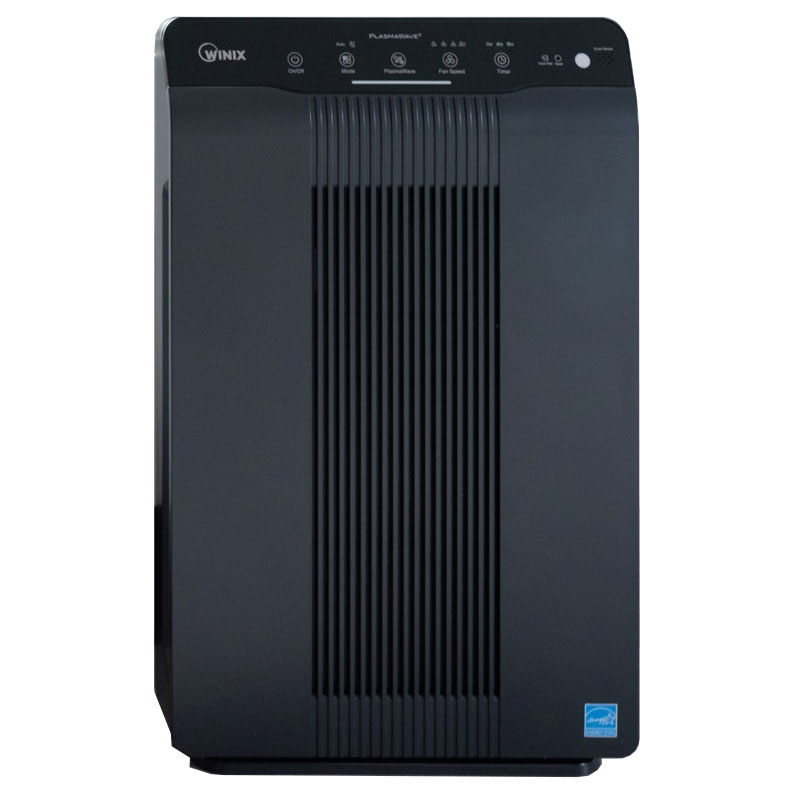
For a reasonable balance between price and performance, our frontrunners were the Winix and the Coway. The other five systems we considered sometimes had slightly better technical specs, but these tiny increases in coverage equalled hundreds of additional dollars upfront, often for machines that were bulky or counterintuitive to use.
We preferred the Winix, finding it a little easier to use and a little cheaper than the Coway. But honestly, they’re so similar that choosing between them comes mostly down to aesthetics. In terms of performance, both have nearly identical pre-filters, true HEPA filters as their primary purifiers, and some sort of charcoal filter to absorb odor. (The Winix has little pockets of charcoal nubs; the Coway has charcoal foam, like what you get in your kitchen compost bin, or on top of a litter box.)
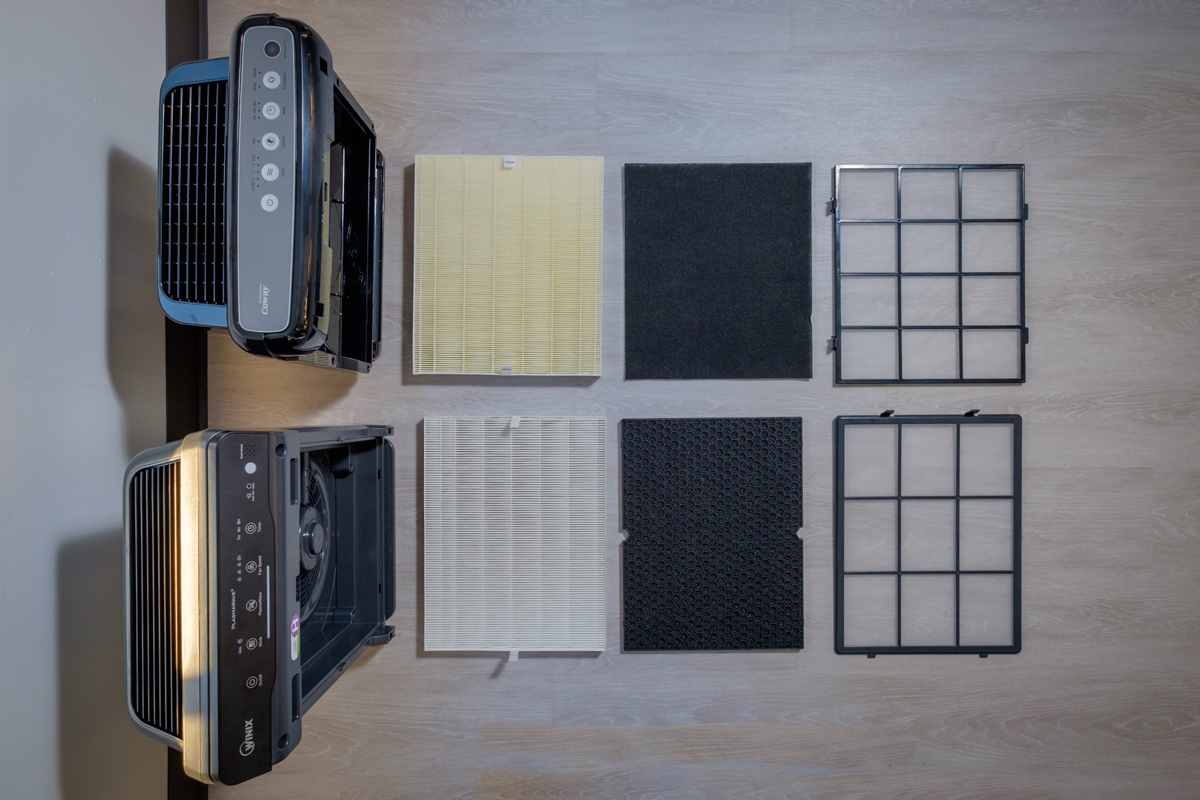
The Coway (top) has a nearly identical filtering system as the Winix (bottom).
The Winix 5500-2 technically has lower CADR ratings than the Coway, but the difference is incredibly small — for smoke the Winix has a rating of 232 and the Coway has a rating of 233 — but the Winix is typically priced at least $50 cheaper than the Coway. (We’ve seen it retail for nearly $100 less on Amazon and Home Depot.) Rather than focus on negligible differences, we like the Winix because it excels at cleaning our air and provides a better value.
Other than price, the differences between our top two picks boils down to looks and maintenance — and even those are nit-picky. We prefer the matte charcoal Winix to the glossy Coway, which was a magnet for cat hair and dust. And even though the Coway is cuter in an alien-TV sort of way, the taller, slimmer Winix ended up a more discreet room addition. (The same could not be said for large units like the Winix U450 or Electrolux. The Winix U450 was a bit too bulky for our taste, while the Electrolux’s high setting was so loud it made our tester feel like they were riding an airplane.)
Popping the hood of the Winix was easy. The cover uses magnets to snap in and out of place, and each filter locks inside the next — there’s no question where each piece should be when you’re taking it apart and then putting it back together to replace the filters. The Coway is much flimsier, and it takes a couple of tries to put the front and pre-filter back on after you remove them. It’s not a deal breaker, but if you’re taking it apart every two weeks to rinse out the pre-filter (which is recommended for both units), the Coway is more of a hassle.
How did other models compare? Put simply, none could compete with the Winix 5500-2. Even the other Winix model that we tested, the larger U450, was less impressive, with a filter design we found less intuitive to replace. And replacing the filters for the Kenmore and Honeywell forced our tester to consult the manual multiple times. The front panel for the Kenmore had a tendency to stick when being opened or closed, leaving our tester worried about breaking it.
As for extra features, the Winix 5500-2 touts bamboozling proprietary PlasmaWave Technology, which, when activated, claims to “instantly neutralize airborne viruses, bacteria, chemical vapors, odors, and gases” (!!!). It also produces positive ions which avoids the “grounding of junk” that standard ionizers suffer from. We didn’t really take this particular piece of marketing seriously — in fact, if it had jacked up the price, we likely would have skipped recommending the Winix altogether. But it didn’t, and the unit offers more useful features like intuitive controls and a built-in air quality sensor that decreases the speed setting to save power when the air quality is good. The Winix also has timers and sensors that measure air purity, with glowing LED lights that shift from blue to red the more polluted the air. On its Auto setting, the Winix will automatically runs the fan at its lowest when the air quality is good — a nice touch for saving power. (Although even here, the Coway offers similar features.)
Admittedly, there are more powerful air purifiers on the market. The Winix U450 ($440) has higher CADR ratings, but you’re only paying for an additional 100 feet of square coverage, plus a pre-filter treated with something called “Antimicrobial CleanCell Protection,” which is supposed to help reduce the development of bacteria, fungi, and mold. We’re not convinced. If you’re worried about bacteria, we think you’re better off putting two Winix 5500-2 units in opposite corners to make up for the square footage and using the leftover cash to stock up on hand sanitizer. The Winix U450 is a nice alternative if you must have a single purifier or the most powerful unit available. But the Winix 5500-2 is our top choice for having impressive CADR ratings and affordable price which makes it a breath of fresh air in the complicated world of air purifiers.
A Very Close Runner-Up
Coway 4-Stage Filtration System with Air Quality Indicator A more petite purifier also rated for 360 sq. feet, and with the cheapest filters we saw. Long-term, this one is the better deal.
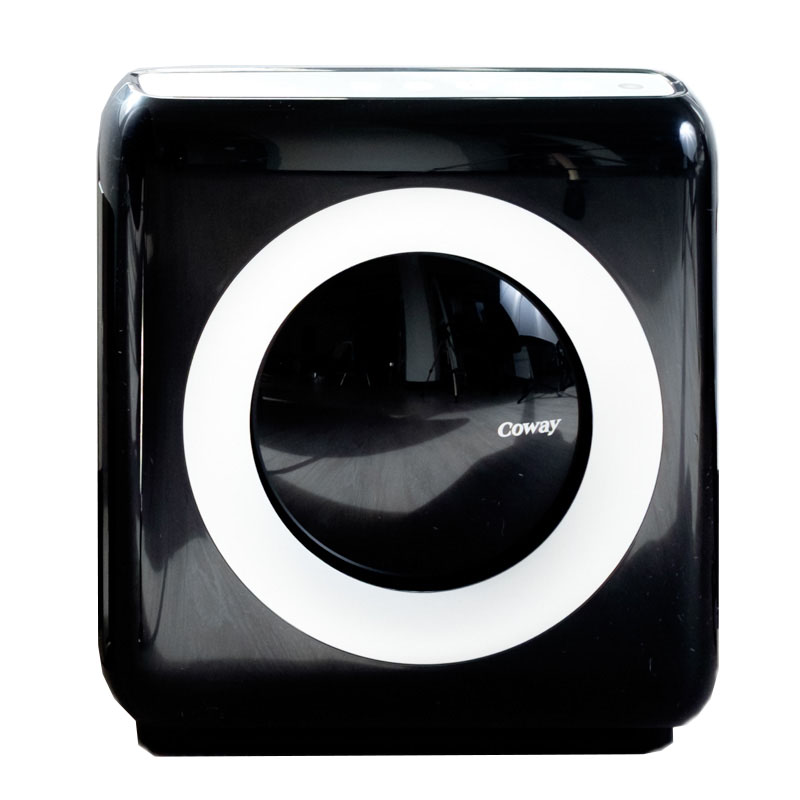
The Coway 4-stage Filtration System is also an impressive model. If it weren’t for the higher price and the greater hassle with swapping filters, it would likely be our top pick.
The Coway is a touch better than the Winix in terms of CADR ratings for smoke and dust (although slightly worse at capturing pollen), and it also excels in number of air changes per hour. At the max setting, the Coway averages five air changes for a 360 square foot room with a nine foot ceiling — the average ceiling height of a home. The Winix only averages four and a half air changes. But like CADR ratings, the difference is small, and both numbers exceed the minimum recommendation by our experts.
Another bonus is that the Coway has cheap replacement filters. In the long term, the costs of the Coway will eventually turn into savings. If you use it for at least five years, it will theoretically average out to be cheaper than the Winix. (We calculate the full annual cost of running each machine below). The Coway is an excellent air purifier that won’t disappoint in the off-chance that the Winix isn’t available, or if you just prefer the Coway’s aesthetic.
Did You Know?
For long-term costs, factor in replacement filters and energy use.
Air purifiers aren’t a one-and-done purchase — replacement filters and energy use will affect your bottom line, especially considering that air purifiers are typically left on all the time to do their thing. Figuring out the long-term cost out takes some fast math.
To predict your electric bill, you need to know how many kilowatt-hours your purifier uses per day, multiplied by the average electricity rate where you live. Let’s use our top pick as an example: The Winix 5500-2 runs at 70W, or 1.68kWh. Denver electricity runs is 11.05 cents per kilowatt-hour. To run the Winix 5500-2 all day every day for a year, you’re looking at about $68 a year added to your electric bill.
Replacement filters are less complicated. The Winix HEPA filter is about $80 a pop; the Coway is closer to $50, and you replace each about once a year. (Replacement secondary filters are included with each machine’s replacement HEPA filter.)
Winix 5500-2 |
Coway 4-Stage Filtration System | |
|---|---|---|
|
|
| |
|
|
|
|
|
|
|
|
|
|
|
|
|
|
|
|
Because the Coway’s HEPA filters are such a good deal, the costs after a year are nearly negligible between our two top picks. After five years, the Coway may end up costing you less.
Placement is key.
Make sure your air purifier isn’t flush against walls or furniture, as most units work best when they can take in air from all sides. In a bedroom, situate the purifier roughly 6 to 10 feet from your bed (specifically, the headboard), with the registers facing you — this should help facilitate the flow of clean air toward you while you sleep.
“Air purifiers are especially critical during the sleeping hours when lung function naturally decreases, making the airways more susceptible to irritant inflammation.”
In addition, the closer you sit to your air purifier, the cleaner the air will be. Wu explained that “usually, if you sit closer to the air purifier, you’ll get a gradient of clean air that’s better. Over time, as long as it’s in an enclosed space, it’ll average out.”
You can improve the quality of your air even without an air purifier.
A purifier can help mitigate pollutants in the air, but it won’t cure your allergies or rid your home of pet hair. It’s worth it to develop a few good habits to help keep airborne irritants out of the home.
Vacuum your floors frequently.
Carpets hold lots of dust, pollen, and other irritating particles. (In fact, for people with who asthma or allergies, living without carpet is the best option.) But vacuuming can help improve air quality, especially if you use a vacuum with a HEPA filter. As with air purifiers, this filtration system helps ensure that the dust particles sucked up by the vacuum don’t escape back into the air. Two of the vacuum models that we tested and liked when we reviewed Best Vacuums use HEPA filtration systems and are good for both carpeting and hardwood.
Check the outdoor air quality, and if it’s good, open your windows to let fresh air in.
Ray Wu told us that “if the air is good outside, open your window. It can improve the health of your environment. Air purifiers don’t generate oxygen or remove carbon dioxide; that’s why you want some fresh air.” His advice was to look online at weather channels to check for the outdoor air quality. In addition, if you live near a bunch of traffic or in a city, he advised not to open windows during peak traffic. Instead, Wu says to “wait for when there are less cars so you don’t pick up that pollution.”
Bathe your pets regularly.
Pet dander is especially tough to manage, because it doesn’t stay airborne for long, often settling into carpets and onto walls and furniture before an air purifier has time to capture it. Keep dander at bay with regular bathing and brushing — and plenty of vacuuming. Feel your allergies flaring up at night? It might be worth it to keep those pets out of the bed while you sleep. (We know. Easier said than done.)
Strive to keep your home’s humidity around 30–50 percent, which helps keep mold in check.
You can use a hygrometer to measure humidity levels, but there’s a simple way to do a quick check: If there’s fog and condensation on your windows, your home’s humidity level is probably too high and you may need to invest in a dehumidifier.
Ask your guests remove their shoes before coming inside.
It’s probably not a surprise, but shoes are dirty. They can track in harmful bacteria, dust, and other debris that can affect the air quality of your home — not to mention give you more to vacuum. Leaving shoes at the door prevents these risks.
Don’t smoke or allow smoking inside your home.
The jury is in and has been for a while: Smoke is bad for your lungs and the air quality of your home. Smoking outside or not at all helps ensure your indoor air quality stays clean.
If you use a space heater during the winter, give it a good cleaning every few months.
Have you ever smelled something burning when you plug in your space heater during the first cold snap of the year? Chances are that smell is burning dust, which tends to accumulate on the surface guards of heaters. Giving your space heater a clean before use can help prevent the spread of dust as well as that bad smell. (In the market for a new space heater? Check out our favorites.)
CADR ratings are the best measurement for performance, but aren’t without flaws.
While CADR ratings give the most accurate representation of an air purifier’s ability to actually purify air, this testing method isn’t perfect. It doesn’t do anything to measure gaseous pollutants or very small particles (anything below the 0.3 micron threshold that HEPA filters are able to catch). Plus, they only include results for the purifier on its highest setting.
That said, CADR ratings are currently the best option available, and these results are trusted by organizations like the EPA and Consumers Union. We’ll keep an eye out for new testing procedures, but in the meantime, CADR remains the best way to gauge which air purifiers are the real deal.
The Best Air Purifier, Summed Up
Table of Contents

We find the best of everything. How? We start with the world. We narrow down our list with expert insight and cut anything that doesn't meet our standards. We hand-test the finalists. Then, we name our top picks.